Monday, March 29, 2010

An Infinite Expectation of the Dawn

I heard someone say recently that poetry was best enjoyed by the young because they had not become jaded yet. I find myself enjoying poetry more as I age because I am able to understand on a deeper level what the poem really means. What I think about cynicism is that it is a choice. You have to choose to meet the world fresh and new every day. I do not say this out of a naive life experience lacking pain. I’ve learned this because of the hard parts of my past. Allowing yourself to be jaded is actually the easy way out. It’s the easy path to not being hurt again, but it’s also the path that misses the most beautiful parts of life. It’s the path that ignores Thoreau’s exhortation when he wrote:


“We must learn to reawaken and keep ourselves awake, not by mechanical aids, but by an infinite expectation of the dawn, which does not forsake us in our soundest sleep. I know of no more encouraging fact than the unquestionable ability of man to elevate his life by a conscious endeavor. It is something to be able to paint a particular picture, or to carve a statue, and so to make a few objects beautiful; but it is far more glorious to carve and paint the very atmosphere and medium through which we look, which morally we can do. To affect the quality of the day, that is the highest of arts. Every man is tasked to make his life, even in its details, worthy of the contemplation of his most elevated and critical hour.... I went to the woods because I wished to live deliberately, to front only the essential facts of life, and see if I could not learn what it had to teach, and not, when I came to die, discover that I had not lived. I did not wish to live what was not life, living is so dear; nor did I wish to practise resignation, unless it was quite necessary. I wanted to live deep and suck out all the marrow of life....”

Thursday, March 25, 2010

Something There is That Does Love A Book

Of the last three books I’ve read, I’ve had such varying reactions that I’ve been thinking about what makes me love a book. The best explanation I can give is that I love a book that completely consumes me and makes me forget where and who I am for a time and takes me to a place I’d rather be with people I wish I knew. The Story of Edgar Sawtelle by David Wroblewski was such a book for me. I didn’t like the ending, but since I’ve made a vow to myself never to recap plot, I won’t explain much except to say that I never like endings about death. The two other books I’ve read lately I liked less. The Reluctant Widow by Georgette Heyer I found diverting at best. I didn’t dislike it and will read another book by her when I am in the mood to be entertained mindlessly. Do Androids Dream Electric Sheep? by Philip K Dick I found to be underdeveloped. It felt thrown together or unfinished to me. I liked the premise of the book and the plot points, but it felt like an outline of a plot that could have been a great book with some character development and more extension of the story.


It’s been several days since I finished Edgar Sawtelle, and I find myself missing the characters and places of the novel. That’s what makes a book one of my favorites. When it’s over, I miss being in the midst of it. A quote from the book explains best this feeling of connectedness that I miss when it’s gone: “On those nights, he felt connected to something ancient and important he couldn’t name” (p 11). We can consider ourselves lucky every day we are allowed to feel connected to something bigger than ourselves. Literature isn’t the only path to this oneness even for me, but it is one of the ways I remember, at a deep-seated, not completely rational level, that I am participating in the history of humanity just by virtue of being alive.


Monday, March 1, 2010

The Lacuna by Barbara Kingsolver

"The untouched ones spend their luck without a thought, believing they deserve it" (p 462).

I am so far behind in posting about Barbara Kingsolver’s The Lacuna. Simpler books that I like less are much easier to review. The characterization, plot, and themes of The Lacuna were complex enough to force me to procrastinate about my blog post. I suppose the simplest way to describe the book is to say that it follows one man’s life from childhood to death as he lives through crucial turning points in history in both Mexico and America. The main character, Harrison Shepherd, is involved directly in so many important occurrences as to lend a Forrest Gump feel to the plot. I’ve always liked Kingsolver’s fiction and nonfiction, but with The Lacuna, her work seems to have matured and expanded beyond even what I had come to expect.

The first important theme is Harrison’s challenging relationship with his own mother. He grows up feeling like a neglected satellite orbiting a beautiful, but dangerous, star. This theme carries over into the next segment of his life where he happens upon a job in the Diego Rivera / Frida Kahlo household. Harrison develops another close but tumultuous relationship with Frida, who overtly introduces the lacuna theme, which was only hinted at in the prior sections of the book. She repeatedly tells Harrison that the most important thing about a person is the thing you do not know about him. I continue to struggle with this idea. Intuitively, I sense an important revelation in these words that I have not been able yet to grasp rationally. The lacuna theme is carried throughout the book in both physical occurrences: an underwater cave, a lost notebook; and in figurative ones: the idea of important gaps in our knowledge of one another. Toward the end of the book, Violet Brown, who has been Harrison’s secretary for years, says, "Those news men could not make a thing true just by saying so. It’s only living makes life" (p 445). I like the extension of the idea of how when we have gaps in our knowledge of others, we often project on them what we would like to pretend fills those gaps. I suspect that most of the time, we err in our suppositions.

Being a Kingsolver novel, issues of social justice occur throughout. There is a scene early in the book about the Bonus Army March, as well as a section about the Advancing American Art auction, which was a perfect example of typical government forethought and efficiency, neither of which I knew anything about. Then later, during the period that Harrison works for Frida, Leon Trotsky lives with them, leading to much discussion about the Russian Revolution and about revolutions in general. The last part of both the book and of Harrison’s life is spent amid the Communist fear-mongering mania of mid-twentieth century America. Many of the themes and occurrences during this embarrassing period of our history resonate in the fears and abuses that occurred in America in the post 9/11 years, reminding me yet again of the oft-repeated and hard to cite adage that forgetting history dooms us to repeat it.

I suppose I would say that the most important theme that I find in this or in any other Kingsolver work is the idea that happiness should belong to us all, that being different shouldn't exclude you from the joy and beauty of this life, and that in the end, love and acceptance are the only things that really matter.

Monday, February 1, 2010

Approaching Frida

I thought I would wait until I finished The Lacuna by Barbara Kingsolver to post about it, but the story has begun to overwhelm me with new ideas. One of the most promising new ways of thinking that I am coming to is in my approach to Frida Kahlo. Being a naturally optimistic and happy person, I tend to shy away from dark, pain-filled art, books, films, etc. I have had enough sorrow to have lived my own darkness, and I usually don't want to be confronted with someone else's version of grief. I like art that ennobles and improves my life. So, in the past, I have shied away from Frida, because she is hard. She is hard to love and hard to understand. Reflecting on her work now, my impression is that she felt wounded and raw and wide-open to the grief of the world. But I also suspect that she loved her life and hated her pain and took all she could from both. She was dealt so many successive hard blows, and she just kept coming back for more. What bravery and what strength it must have taken to display her pain to a critical world in her work as she did.

I suspect she is much misunderstood because she is not easy. She was probably a pain in the ass to love, for friends and family alike. There is no one path to understanding her, and there are no simple interpretations that will lead you to her. I'd like to make that kind of complexity a personal goal. Interesting people may be easy to approach, but they cannot be captured with one word, or one picture, or even one idea. They are often a mass of beautiful contradictions. You just have to plunge in, grab hold of something, hang on, and enjoy the ride of knowing them.

Tuesday, December 29, 2009

New Discoveries

Life has a way of spilling over and washing away time spent on reading and blogging, and I have been particulary adrift with living of late. Always better to live life than to read about it. I have, however, made a few discoveries to share this holiday season.

I watched and enjoyed a French film called Jean de Florette, in which Gerard Depardieu plays a city tax collector who moves to the country after inheriting his grandfather's farm in Provence. Jean's is a soul full of music and poetry. He is in love with his life and with his new surroundings. He has grand plans for the farm, which are foiled by two neighboring farmers. The film ends abruptly and needs to be followed by a direct viewing of part two, Manon of the Spring. My disk from Netflix, however, would not play side two, so I am left hanging.


In the realm of music discoveries, my yoga teacher introduced me to a new-to-me pop artist, Kate Earl from Chugiak, Alaska. I bought her self-titled album from itunes and particularly like Melody and Nobody. Have a listen: http://popup.lala.com/popup/432627054054098921.


On the literature front, I have just begun to read the poetry of Anna Ahkmotova. Here is one of my favorites:

Along the Hard Crust

Along the hard crust of deep snows,
To the secret, white house of yours,
So gentle and quiet –
we both are walking, in silence half-lost.
And sweeter than all songs, sung ever,
Is this dream, becoming the truth,
Entwined twigs’ a-nodding with favor,
The light ring of your silver spurs...
Translated by Yevgeny Bonver, July, 2002
Edited by Tatiana Piotroff, September, 2002


Reading has not ceased completely. During our recent snowstorm I read The Dark is Rising by Susan Cooper, which was a perfect read for a snowstorm. I found it to be well-written (for its genre) with a plot I enjoyed enough to read the others in the series soon. Currently I am in the midst of a work of nonfiction entitled The Nothing That Is -- A Natural History of Zero by Robert Kaplan, a book which is interesting enough to deserve its own blogpost at a (I hope) not too much later date.

Monday, November 16, 2009

In Which I Defend My Recent Junk Food Diet

I promise I have not ceased to be, nor have I ceased to read. Autumn at my house means one thing: I am reading my equivalent of junk TV--murder mysteries. It seems like every year when early darkness and Halloween roll around, I gravitate toward mysteries, which I read until I am sated. I can't join the fun and watch scary movies or read scary books, because I want to sleep again before I die, but murder mysteries I can handle. In my defense, I do try to choose fairly well-written mysteries. I opt for nuanced plots and lots of mood, setting, and character development. After reading novels set in different historical periods, you feel like you have traveled to some distant place and time. The better-written of these books can improve both your vocabulary and your knowledge of history. Besides, anything that makes your life more enjoyable can't be a complete waste of time.

So, to Ms. E, who asked me tonight, "Read any good books lately?" Here's the list. I'm still working my way through some of these:

Elizabeth George's Inspector Lynley series;
Laurie King's Mary Russell/Sherlock Holmes series ;
Ariana Franklin's Mistress in the Art of Death series;
Lindsey Davis' Marcus Didius Falco series;
Ellis Peters' Brother Cadfael series, and
CJ Sansom's Matthew Shardlake series.

Happy reading, people. Remember, more darkness just means a built-in excuse for tackling that TBR pile.

Tuesday, October 20, 2009

Mistress in the Art of Death by Ariana Franklin

Why do people go to such trouble to avoid the truth? Living lives carefully constructed to prevent ever having to bare yourself to the often abrading wind of reality. It must be exhausting to run in the convoluted circles required to ascertain that you never come upon a mirror for your soul. Piece by piece, building a facade that is not you to present to the world because you are so afraid that an unedited, unembellished presentation of yourself would be found wanting or even worse, repellent. I cannot abide people who spend their lives hiding reality, whether the construct is physical, spiritual, or both. I had never realized that the feeling might be mutual. In Mistress in the Art of Death by Ariana Franklin, a rabbi tells Dr. Trotula: "truth produces hate for those who speak it." Read the book if you like historical, medieval mysteries and especially if you like to read about a smart, strong woman who's not afraid to tell the truth. I liked the book enough to buy the next in the series, which I am reading now, and I ordered the third tonight. I would not suggest the book for youngsters. (The above rant is my own and is related more to my own life than to the book.)


Thursday, October 8, 2009

Be Still and Know

When I was younger, and far more religious, my favorite Bible verse was "Be still and know that I am God." Although I spend more time with poetry now than with the Bible, the sentiment is still one of my favorites. Another favorite quote of mine has been "If you do not understand my silence, you will not understand my words." I think often of the idea of silence as I go through life being overwhelmed with the constant noise of our world. Why do we feel that every moment must be filled with something? Why can a moment not just be? Just stand alone on its own in its silence? This idea seems to dance around the edges of my consciousness. I am often confounded by my inability to find silence in my daily life. I feel so out of sync with society for needing such isolation. A few years ago I came across a Dixie Chicks song called Easy Silence that spoke to this need in me: "And I come to find a refuge in the easy silence that you make for me. It's okay when there's nothing more to say to me...and the peaceful quiet you create for me, and the way you keep the world at bay for me." The need for a refuge in silence can be as compelling as the need for warmth and shelter. Sometimes all we need is someone to keep the world at bay for us.


I finally finished reading The Princes of Ireland by Edward Rutherfurd. I had the same experience with this book that I had with his book, London. I enjoyed the book until about 500 pages in, when it began to drag and repeat itself. Then I enjoyed the last 100 pages. I guess I just don't have much patience with a book that takes me a month to read. I feel like I have so little time to read that I should only devote an entire month to a masterpiece. I did, however, find enlightenment in the middle of the book. I often have trouble describing to people what art, poetry, or music gives to me. A quote in the books sums it up: "Do you see how it glimmers? It's as if you could step right into the page; and once you are there, you encounter...a great silence." I remember the first time I was in Paris seeing one of Monet's large lily pad paintings. I had the strangest feeling as I stood there, as if the world around me was fading and becoming silent, as if I could take a step forward and be there by that pond, in that world. That's what all art gives us -- a chance to be quiet with who we are and to connect on a spiritual level with the people who went before us who saw the world as we see it now. It tells us that we are not alone.


Sunday, September 20, 2009

Without Music Life Would Be A Mistake --Nietzche

I've been thinking a lot about music lately -- its endless variety and its effect on this species we're all part of. Isn't it amazing to think about how many types of music and how many songs exist, yet for the most part, they're all different, like human faces, existing in seemingly endless varieties.

Sometimes, knowing a person's musical taste can tell you a lot about that person, but in my case, I love it all. My ipod shuffles from Green Day to Bob Marley to Hazel Dickens. My musical tastes remind me of Millie's comment in Bull Durham about Nuke LaLoosh: "Well, he f**ks like he pitches. Sorta all over the place."

Think of the ability of music to move us to laughter, tears, joy, sorrow. Within the first few bars of a good song, your entire mood and frame of mind can shift. If you're tense, you might relax. If you're sad, you might find yourself smiling. Does anything else so easily affect our emotions? Music may be man's most sublime invention. As Victor Hugo observed, "Music expresses that which can not be said and on which it is impossible to be silent."


Tuesday, September 15, 2009

Come On to My House

So once again, I’ve found the man of my dreams. Only, he’s not real. Typical. The main character of the first part of The Princes of Ireland is a prince (surprising, I know) who wants to be a druid, and not a prince. He is drawn to the solitary, introspective life of philosophy and poetry and is described as quiet, deep, and thoughtful. He meets my requirements of fun, funny, smart, and serious. Now if he could just look like Henry Cavill in The Tudors and come on to my house, life would be perfect.

“…since his early childhood, when he had sat alone by the lakes or watched the red sun go down, he had been overcome by a sense of inner communion, a feeling that the gods had reserved him for some special purpose. Sometimes it filled him with ineffable joy; at other times it seemed like a burden.” (p 57)

Barring some bizarre rabbit-hole experience leading this man to my house, I guess I’ll just have to settle for finishing the novel.

Saturday, September 12, 2009

Fear From Insight

In the song, Do You Love Him, by The Avett Brothers, one of the lines refers to being able to tell the difference between fear and insight. It's a distinction I think some people may not even realize exists. I don't know that I could have named it, but as soon as I heard it, I knew someone had put words to a concept I struggle with in my own life. I like to believe I govern myself by insight, but I wonder if sometimes, insight becomes fear, and I begin to make decisions based on fear rather than insight. Or maybe fear is born of insight. Some experiences, and the knowledge resulting from those experiences, alter your perspective forever. After your life veers in directions unforeseen and unexpected, you can't ignore the insights you receive. I suppose the real answer is that there is no real reason to fear anything, since we often have little control over the directions our lives take. Ergo, fear is a complete waste of time.


On another note, I am still reading, just have been lazy about blogging. Since finishing Michelangelo and the Pope's Ceiling, I've read the following:

Death at La Fenice by Donna Leon
Watchmen by Alan Moore & Dave Gibbons
Careless in Red by Elizabeth George
Dark Fire by CJ Sansom

Right now I am reading The Princes of Ireland by Edward Rutherfurd. It's a well-written historical fiction saga set in ancient Ireland. Maybe soon I will find time to blog about some of these great books. I would recommend any of them.


A Kind of Healing

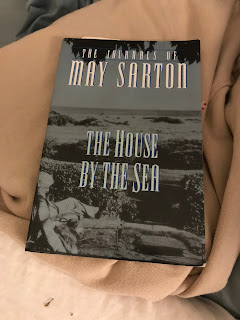
  "...to live the slow quiet rhythm of a day as a kind of healing" Several years ago, I discovered May Sarton’s journals. What a b...