Showing posts with label Margaret Atwood. Show all posts

Sunday, September 17, 2017

The Innocent Murderess


How many times have I aimlessly wandered the aisles of a bookstore picking up and putting down books whose covers catch my eye? How many of those times have the books I've bought either collected the dust of years on shelves unread or been read and completely forgotten?  One mislaid day in 2002, the book goddess smiled on me, and I happened upon my first Margaret Atwood. I had no idea who she was at the time and have no idea to this day why, on one of my rambles through a bookstore, I picked up a copy of Alias Grace. What I do know is that for the next 15 years, if pressed to choose a favorite book, this random treasure was it. All my life, I've read so much that I struggle to choose a favorite book, but somehow and for reasons I still don't fully understand, this one caught me.  After all the intervening years and so many more books, including new Atwoods, I will have to revise my assessment to say Alias Grace is now one of my favorite books.

This summer, my daughter read it for the first time and urged me to re-read it. As usual, in Alias Grace, Atwood defies easy categorization.  Psychological thriller, historical fiction, gothic mystery, interpersonal drama, character development and study, elements of all those fill the pages of this entertaining read. Just like many of the novel’s characters, I found myself captivated and haunted by the ever elusive Grace. Is she a cold-hearted, calculating murderess or a naïve, innocent rube?  Or, as I suspect, like most of us, is she much more complex and nuanced, harboring some qualities of both?

Maybe the not knowing, the uncertainty is the point. Once again, Margaret Atwood proves to be prescient. With all the recent discoveries about the fallibility of memory, with all the current failings of justice in our country and our world, and with some of our deepest spiritual leaders finally beginning to address the darkness as well as the light in all of us, we would all do well to learn to pause and think and reserve judgment more often than passing it.  The cautionary tale of Grace Marks teaches us, if nothing else, that the voiceless and the vulnerable are always the easiest to blame.  But is that kind of easy injustice what we want to embrace?

Sunday, February 26, 2012

What Makes Life Worth Living?

Can a person be too broken by his life to be saved?   In The Year of the Flood by Margaret Atwood,the convicts who come out of the novel’s version of prison, Painball, are no longer human.  They have moved into the realm of cunning, intelligent animal predators and must be treated as such.   But there are other ways this concept applies too.  It is possible to be so emotionally broken that you can’t be fixed.   At worst, people retreat into insanity; at best, into a hermit-like existence devoid of the society of others.  They become as emotionally afraid of others as the novel’s characters are physically afraid of the Painballers.   They retreat from a reality they see as uninhabitable.  But what if reality really did become uninhabitable?
The last two novels I’ve read have had plots and themes about the dissolution of our society.  In The Hunger Games, the country has become a totalitarian state with no protections for the individual in a society governed by group think and propaganda.  In The Year of the Flood, the “waterless flood” has washed away any semblance of society.  When society breaks down, and there is not only no safety net but no safety at all, emotional and physical pain become the most prevalent experience for humanity.  One of the main characters in The Year of the Flood observes that sadness may be a kind of hunger. It makes sense to think that when you are sad, it is because you hunger for something you don't have.   Sadness and hunger become the rule rather than the exception in a dystopic society.  I suppose when you get to the point of living all the time in survival mode, you don’t have time to ask yourself questions about the purpose of your life or about the direction of your species.  You learn to live in the moment and to continue to live only so others later may be able to live more easily than you.  But I can’t imagine wanting to stay alive in a world like that.  Good thing the propagation of the species doesn’t depend on me.  If society collapsed, I’d be one of the first ones tagging out, I’m afraid.

Tuesday, February 21, 2012

This I Believe?

“The Human reason is a pin dancing on the head of an angel, so small is it in comparison to the Divine vastness that encircles us.”   Adam One in The Year of the Flood by Margaret Atwood

Most of my life I have felt at a loss to explain my feelings about religious faith. Oddly enough, I seem to lack the words.   I don’t like the terminology applied to any of the existing categories.  I am not a religious person, nor am I devoid of spirituality.  I do not consider myself a “believer” in the world’s use of the word, nor am I precisely agnostic and certainly not atheistic.   Atheism is as strong a form of belief as any dogmatic religious belief.  It is as faith-based to assert the absence of anything as it is to assert its presence.   Atheism seems to me to be as shallow as blind religious faith.   I want a new term to describe those of us who are comfortable admitting  the empowerment of spirituality and the probability of something bigger than humanity  (be it god or science, why does that matter, those are just human words),  and equally comfortable admitting the errancy of blind faith.  Faith and belief are not the same thing.  Faith requires an irrational leap, a suspension of what you know.  Belief, on the other hand, is the result of much contemplation.  I think humanity has little capacity to grasp infinite truths, but our inability to understand them doesn't mean they don't exist.

Sunday, February 12, 2012

Three Day Week-ends! Now!


It's Sunday night, and once again, I've spent the week-end running around too much to read enough for my liking.  I'm thinking a new law may need to be enacted to provide a three, if not four, day week-end to accomodate both my reading and my life.

The few times I've been able to sit down with my current read, I've been swept up in a world that only Margaret Atwood could imagine.  I love the way her mind works.  So often in her work, small details emerge that make me feel like I'm in on some obscure, clever, inside joke, where she interprets the outcomes of current events in ways most people would never predict.  I've only had time to delve a small way into Year of the Flood, but it promises to be as engaging and entertaining to me as I found Oryx and Crake to be ten years or so ago. 

I did spend this morning catching up on book blogs I try to follow, but there are two problems with reading book blogs.  One:  you are not actually reading your book, and two:  you proceed to want to read almost every book you read reviewed.  For a person with a TBR pile numbering the hundreds, this becomes a frustrating exercise in futility.    So here we go headed into another busy work week, where falling asleep by nine is the norm, and time to read becomes as realistic as the three day weekend.  Happy reading to all you independently wealthy and/or retired and/or smarter than me people who have just said screw it to the capitalistic society that holds the rest of us hostage. Here's hoping for more hours in the day or more holidays in the year.

A Kind of Healing

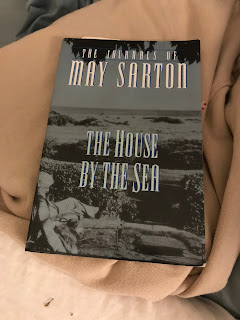
  "...to live the slow quiet rhythm of a day as a kind of healing" Several years ago, I discovered May Sarton’s journals. What a b...