Showing posts with label Cheryl Strayed. Show all posts

Friday, November 8, 2013

Stranger Than Fiction


photo by amy

"Somewhere, something incredible is waiting to be known."  Carl Sagan

As recently as a couple years ago, I almost never read nonfiction.  I don't know exactly why, but I suspect it relates to my use of reading as a means of escape.  Over the last few years, however, I've discovered that nonfiction is often precisely what I need.  With that in mind, and following this month's theme of Nonfiction November, here are some of the nonfiction books I've read over the last couple years that I would recommend. 

Guns, Germs, and Steel by Jared Diamond:   An engaging book providing Diamond's hypothesis for why Western Civilization evolved as it did.  This book is so full of interesting facts that I spent almost as much time making notes as I did reading.  I loved the PBS series from this book.  I've bought Collapse by Diamond to read but haven't yet gotten to it.

The Year of Magical Thinking by Joan Didion:  A memoir of the year directly following the sudden deaths of her husband and concurrent serious illness (and later death) of her daughter.  So much of what Didion describes resonates with me because of my experience of my brother's sudden death in an auto accident when he was 16 and I was 21.  I also read her later memoir Blue Nights.

The Grand Design by Stephen Hawking and Leonard Mlodinow:  An interesting, approachable, understandable description of different theories about the origin and nature of the universe and humanity's differing historical views of it.  I would assume this book might be too basic for most scientists but is a good overview for the rest of us. 

Wild and Dear Sugar by Cheryl Strayed:  While both of these books are quite different, I loved the author's voice and points of view in both.  Wild is a memoir of the author's ill-planned hike on the Pacific Coast Trail in the wake of her mother's death and her own divorce.  Dear Sugar is a collection of question and answer advice columns on pretty much everything involved in being human.

The Violinist's Thumb by Sam Kean:  My most recently finished nonfiction work is an explanation and history of genetics.  While some of the book was a little dry, for the most part, I loved it.  Lots of interesting tidbits of info on the underlying stuff of life on this planet.  My favorite part was on epigenetics. I have Kean's Disappearing Spoon, which explores chemistry, to read soon.

When You Are Engulfed in Flames and Let's Explore Diabetes With Owls by David Sedaris:  I listen to all of Sedaris's books on audio, narrated by him on my iPhone on long car trips.  The vignettes move from the hilarious, to the disturbing, to occasionally ho-hum, but are very often emotionally moving.  As I have lived in North Carolina my entire life, I feel like I'm hearing stories from an eccentric neighbor when I listen to him.  My favorite of his collections has been Dress Your Family in Corduroy and Denim.

My current nonfiction read is Spillover:  Animal Infections and the Next Human Pandemic by David Quammen, which explores the history and reflects on the future of zoonotic diseases.  I'm enjoying this one a lot and have his earlier work, The Song of the Dodo: Island Biogeography in an Age of Extinctions to read soon.

Now that I've discovered the joy of nonfiction and the limitless, free education available to those who choose to pursue it, I try to keep a work of nonfiction underway concurrently with the novels I read.  I find these works a nice change of pace perfectly complementing my fiction reading.  Happy Nonfiction November!

Monday, April 1, 2013

Tempus Fugit

photo by Amy Brandon

"Walk without a stick into the darkest woods." Cheryl Strayed
 
Three of the stories Cheryl Strayed tells in Tiny Beautiful Things haunt me.  One is about her mother’s last gift to her, and it haunts me because it happened to me. Her mother’s last gift to her was a coat.  In 1993, when I was five months pregnant with my first child, I went to visit my mother in the hospital.   Her cancer was advanced enough that she begged me to pray for her death and told me she planned to wear the dress she wore to my wedding to her burial.  I was hurried, harried, overwrought, overworked, confused, and not wanting to hear anything she had to say about her death.  It was February.  I breezed into her hospital room coatless, because I’d finally reached the point where nothing I owned fit my growing belly.    Even in the midst of her death, she noticed my lack of a coat, forced cash on me, and made me go to the mall to buy a coat I could fit into.  I kept that coat, ugly and out-dated though it was, until last year. 
The second story Strayed tells that haunts me does so because nothing like it ever happened to me.  She tells of her mother’s buying a child’s dress at a yard sale years before Strayed ever thought of having a child and how her child eventually wears that dress.  This haunts me because my mother never bought either of my children anything, because she never had the opportunity.  Strayed speaks of how quotidian it is to some people to dress their kids in clothes their grandparents bought and of how shimmeringly beautiful that one dress her mom bought was because it was the only thing her mom ever bought for her child. 

The third story haunts me in a good way, because it makes me understand that I am not alone.  She advises a motherless woman’s fiancĂ© to accept the emptiness that is part of the woman he loves and to accept that it will never be ok that her mother died when she was young.  She says that when you lack a parent, it’s like walking around with empty bowls in your hands that you can never fill.  I learned a long time ago that we learn to live around the voids left in our lives by death.  The best way I can honor my mother is to live the hell out of the life she gave me and to love my children the same way she loved me, like there was never anything more beautiful in the history of the world.

Sunday, January 20, 2013

Opening Pandora's Box


photo by Amy Brandon


"I had diverged, digressed, wandered, and become wild."  Cheryl Strayed


There are parts of who I am and of who I have been that I block and avoid like the plague because they are dangerous to me.  Sometimes it is impossible to think about the person I have been.  Sometimes it will break me to reflect on who I once was, and the only way to keep from crashing is to become someone else.  When I chose to read Wild by Cheryl Strayed, I had no idea I was about to spend a month inside the dangerous, wild places of my mind I actively choose to avoid.


I marvel at how lost we allow ourselves to become without the outside world even knowing we are lost.  Only recently have I realized how starved for affection we can become when we go too long without it.  I would not posit that having a mother is the only way to avoid this.  I know that some mothers do not fill this roll for their children, and I know that it is possible to be loved by someone else in such a way that you feel sated and full, instead of starved and alone, but to be motherless damages you in an unnameable, pervasive way.  To those of you still with mothers who want to pass judgement here and say “get over it,” I would answer that this view is easy to take when you are still mothered.  Some of you never had real mothers and so I’m sure will think I was lucky to have had what I did.  I agree.  And almost all you who read this, because you only know me through this blog, will not know that this issue is not a crutch or a well-wallowed bog for me.  What I have realized fairly recently is that I am who I am because I lost my mother when I did.  I am fiercely independent and alone and just as fiercely lonely and at odds with the choices I’ve made that have made me this way.  Repeated detachment subtlely shapes you into an island of your own.  You end up choosing to destroy normal just to keep yourself from falling into it. 

I can be in the middle of a perfectly quotidian day, and one sentence can, as reading Wild often did, lead to this:  how hard it is not to have one person who loves you anyway, loves even the unlovable in you, is on your side justifiably or not.  And then someone will ask me, “What’s wrong?” and I will have to say “nothing” because “everything” is too much.  

You can’t out run, out drink, or out dance the truth, so you may as well calm down and deal with it, and become who you were meant to be. 

Tuesday, December 11, 2012

In Which Wild Wakes Up the Wilderness in Me


photo by Anna Reavis
 
                     “I couldn’t let myself believe it...and also go on breathing...”          
When I first heard of Wild by Cheryl Strayed, I  wanted to read it:  walking alone on the Pacific Coast Trail to try to outwalk the ghosts of your past and the pain inside you sounds  like something I would do or would have done, had I been childless at anytime in the past 20 years.   So last week, when I found it at my small local library, I grabbed it up and put Les Miserable on hold.

I had no idea how hard just getting through the first chapter would be for me.  That’s where I got to last Friday before I had to stop and regroup and decide if I was strong enough at this point in my life to read this woman’s words.  I thought I was getting a hiking memoir.  What I got in the first chapter instead was a reliving of my own mother’s death.  Strayed lost her mother in the same way that I lost mine (except that I was pregnant with my first child at the time) and at exactly the same time in her life.  She had the same kind of intertwined, how could I live without this woman, relationship with her mother that I had with mine.  I even remember struggling to stay awake with her nights, which is almost impossible in pregnancy, because I was afraid she would die while I slept, and then feeling guilty that I fell asleep.  The biggest difference is that I was with her, holding her hand,  when she died, a type of fullness and completion denied to Strayed, and for which I have been infinitely grateful because being present at the moment of death had been denied me when my brother had died a few years before, so already I knew how important it was.  It brought  to mind Sally Field’s speech in Steel Magnolias about being present when she brought her daughter into the world and being present when she went out of it.  This was the one person I knew who had been present when I came into the world.  I’d be damned if I wasn’t going to be there when she left it, no matter what was going on with my body at the time.    
The one big other difference is that I have never tended, nor even been to her grave.  I suppose that is a kind of denial:  denial through ignoring;  close your eyes,  and it isn’t there.  So because I have lived 20 years now in my self-inflicted forgetting,  being surreptitiously overwhelmed with this issue in a hiking memoir completely took me aback.   Here are some of the last words of the first chapter:  “Nothing could ever bring my mother back or make it okay that she was gone…It broke me up.  It cut me off.  It tumbled me end over end…I would want things to be different than they were.  The wanting was a wilderness and I had to find my own way out of the woods.”   What motherless child can read words like these and still breathe?  I think I am going to have to make myself finish this book.  Twenty years is long enough to live in forgetting.

A Kind of Healing

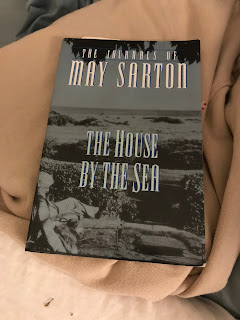
  "...to live the slow quiet rhythm of a day as a kind of healing" Several years ago, I discovered May Sarton’s journals. What a b...