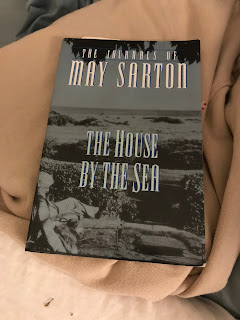
Sunday, October 1, 2017

Just Mind the Freaking Sheep


"There are larger rhythms than just our human rhythms.  It's when we think our rhythms are the only noise, that's when we get in trouble.  How do we stop jabbering long enough to hear something beyond ourselves?" ~John Hay

"In any instant the sacred may wipe you with its finger."  ~ Annie Dillard


I’ve had a hard time getting my thoughts together about David Gessner’s The Prophet of Dry Hill:  Lessons from a Life in Nature.   As I understand it, Gessner began the project intending to write a biography of John Hay, the naturalist author who lived and wrote on Cape Cod in the Twentieth Century.  Lived and wrote may be an understatement in Hay’s case, as it seems John Hay embodied all that was best about Cape Cod prior to its being infected with the cultural equivalent of small pox. Eventually, Gessner decides to write mostly a recording of his conversations with Hay instead of a true biography.

So many ideas are presented and in such a tangential, conversational way that it has taken me about a week to begin to get a handle on them. The most important idea I took away from these conversations is that we keep getting it all so wrong.  Generation after generation, we mindlessly misunderstand our role here and in so doing continue to defile the planet.  We keep running after the wrong things:  money, power, prestige, control, domination, chasing the ever-illusive golden fleece when the whole time we simply should be tending the sheep.  John Hay was one of few people who realized this, thus the word prophet in the title, bringing to mind something Enrique Martinez Celaya said when Krista Tippet interviewed him a few months ago:  "The prophet is not a martyr or mystic who seeks transcendence but one who turns humbly and curiously toward the world."  I would ask that we all try to remember that anything that is beautiful even for one moment and touches the soul of just one person has value and purpose and deserves to be treated with respect.


Sunday, September 17, 2017

The Innocent Murderess


How many times have I aimlessly wandered the aisles of a bookstore picking up and putting down books whose covers catch my eye? How many of those times have the books I've bought either collected the dust of years on shelves unread or been read and completely forgotten?  One mislaid day in 2002, the book goddess smiled on me, and I happened upon my first Margaret Atwood. I had no idea who she was at the time and have no idea to this day why, on one of my rambles through a bookstore, I picked up a copy of Alias Grace. What I do know is that for the next 15 years, if pressed to choose a favorite book, this random treasure was it. All my life, I've read so much that I struggle to choose a favorite book, but somehow and for reasons I still don't fully understand, this one caught me.  After all the intervening years and so many more books, including new Atwoods, I will have to revise my assessment to say Alias Grace is now one of my favorite books.

This summer, my daughter read it for the first time and urged me to re-read it. As usual, in Alias Grace, Atwood defies easy categorization.  Psychological thriller, historical fiction, gothic mystery, interpersonal drama, character development and study, elements of all those fill the pages of this entertaining read. Just like many of the novel’s characters, I found myself captivated and haunted by the ever elusive Grace. Is she a cold-hearted, calculating murderess or a naïve, innocent rube?  Or, as I suspect, like most of us, is she much more complex and nuanced, harboring some qualities of both?

Maybe the not knowing, the uncertainty is the point. Once again, Margaret Atwood proves to be prescient. With all the recent discoveries about the fallibility of memory, with all the current failings of justice in our country and our world, and with some of our deepest spiritual leaders finally beginning to address the darkness as well as the light in all of us, we would all do well to learn to pause and think and reserve judgment more often than passing it.  The cautionary tale of Grace Marks teaches us, if nothing else, that the voiceless and the vulnerable are always the easiest to blame.  But is that kind of easy injustice what we want to embrace?

Sunday, September 10, 2017

The Second Half-Century

 
Anna at Guedelon
photo by Amy Brandon


As I have neared and now passed age 50 over the last couple years, I find myself changing slowly, like a jagged mountain eroding into a smooth stone, more likely now to be prone to naps than to tempests.  As my emotions settle, my mind seems to wake and clear, and my reading interests move in different directions.  Often,  I find myself reading ten or eleven books at a time now. This became possible only when I learned to let go of goal-oriented reading.  Usually, eventually, I will finish what I start, but not always.  Even if I don’t finish, I still find I take something positive away from most books.  I look at reading now more like mining for gold dust than like searching for the Hope Diamond.  Not every book is a diamond, but most contain at least a little pretty dust.

Right now, at this point in my life, I feel like I’m reaching the end of the person I was and am on the cusp of a new and different person.  I hope this new person will be able to write more. I’ve missed writing about what I’ve read.  For a time I came to feel like I either didn’t have anything new to say or wasn’t able to express what I was thinking. Maybe we all have to get quiet and shut down for a while to clear our minds for new thoughts and new ways of being.  Wisdom seems to come at a glacial pace, if it comes at all, no matter how many books I devour, but I will keep on devouring them, looking for those traces of gold dust.

Tuesday, February 28, 2017

We Miss the Log in the Mirror Every Time


"The high point of my day was seeing Frank emerge from the chrysalis of his closet to unfurl his sartorial wings." 

My Book Guru is three for three so far this year.  It's time for another dinner and book discussion so I can get some more ideas! Her third recommendation, Be Frank With Me by Julia Claiborne Johnson is an entertaining little novel about a reclusive author and her ten-year-old autistic son and their "forced" cohabitation and interaction with an assistant from the author's publishing house.

MM Banning (Mimi) is a literary one hit wonder. Upon publication, her only novel becomes a huge hit, quickly earning its place in the school canon, and its author just as quickly retreats into herself, literally and figuratively, and is not heard from again for many years.  (Shades of Harper Lee's life.) During this reclusive period, Mimi mysteriously becomes the mother of an autistic son.  He is her only relative and she his, and for a while, all is well, until she becomes the victim of a scam artist and realizes she needs to produce another book to provide financial security for herself and her son, Frank. In order to write, Mimi needs help tending Frank, thus the presence of Alice, the assistant who serves as the book's narrator, in Banning's home.  Given Frank's propensities, this task becomes almost Herculean in the effort it requires. Most of the book centers around Alice's attempt to find a way to develop a relationship with Frank. I won't say more.  If you want to know how this turns out, read the book.

Several of the novel's themes resonated with me, especially given our current cultural climate. Both Mimi and Frank, each in her or his own way, are almost too sensitive to exist in our society as it stands now. When are we going to learn not only to accept but to embrace and celebrate difference?   It's way past time for us to grow up and stop being threatened by and afraid of difference among us. That's what our bent toward tribalism and isolationism really is...fear.  We are so afraid of those who are different that we band together en masse to expel them from our sight.  How far removed is this from the practice of leaving our weak for the wolves?  Think about that every time you find yourself telling someone to find a way to fit in or to "get over" injustice.  How do we, as a society, respond to people who perpetrate banal and sophomoric cruelties like the ones Frank has to endure in this lovely little novel? Do we reject them, or do we elect them?  Funny how we seem to be able to see the cruelty in others' stories but not in our own.  To paraphrase one of my favorite teachers:  we see the splinter in someone else's eye from 50 feet but miss the log in the mirror every time.

Sunday, January 15, 2017

Undermajordomo Minor


photo by me

"His heart was a church of his own choosing, and the lights came through the colorful windows."

Thanks once again to my friend, Jennifer, for a fantastic reading recommendation!  I think I'm going to appoint her my Book Guru.  I hope she will find the title pay enough.  Feel free to use it as a resume builder, Sister.

When she recommended Undermajordomo Minor by Patrick DeWitt, she said that she had no idea how to describe it or how to explain why she liked it.  I completely concur with that assessment.  It's a quirky novel full of likable characters and witty, engaging dialogue, but I don't really know how to explain exactly what it's about or even why I found it so compelling.  The best description I can come up with is an allegorical fairy-tale-type coming-of-age story about a lovable, dishonest and somewhat self-centered young man who leaves home, gets robbed, gets unrobbed, gets a job, falls in love with his robber's daughter, makes friends with said robber among others, makes enemies, gets murdered, gets unmurdered, finds himself abandoned, becomes unjobbed, and embarks on a quest to find his love and life.  How's that?

Here's what I know for sure:  I loved just about every minute of this book and miss the characters and their snappy dialogue and insouciant attitudes like people I wish I knew.

Sunday, January 8, 2017

Norwegian By Night


photo by me
"Most things are both true and absurd." Sheldon/Donny 

Thanks to a recommendation from my friend Jennifer, I started 2017 off with an entertaining, quirky little book.  Norwegian By Night by Derek Miller is part murder mystery, part political thriller, and part introspective journal of an 82-year-old, Jewish-American, Korean War vet named Sheldon who is also named Donny.

In the last few years I seemed to have been drawn to anything set in Scandinavia, so I particularly enjoyed the descriptions of the countryside as Sheldon/Donny attempts to elude both the Norwegian police and the KLA mafia-type bad guy whose son Sheldon/Donny has inadvertently kidnapped.

The book kept my interest and was a great diversion during the snow storm this weekend. I had never heard of either the book or the author, but I will definitely read his other work.  If you need a quick and entertaining read, I highly recommend this one.  Even better, I found it on Kindle for $1.99.

Thursday, November 19, 2015

Nontraditional Nonfiction


"Until we have found our own ground and connection to the Whole, we are unsettled, grouchy, and on the edge of falling apart...afterward, you know you rightly belong in this world, and that you are being held by some Larger Force.  For some seemingly illogical reason life then feels okay and even good and right and purposeful." Richard Rohr

Nontraditional Nonfiction: This week we will be focusing on the nontraditional side of reading nonfiction. Nonfiction comes in many forms. There are the traditional hardcover or paperback print books, of course, but then you also have e-books, audiobooks, illustrated and graphic nonfiction, oversized folios, miniatures, internet publishing, and enhanced books complete with artifacts. So many choices! Do you find yourself drawn to or away from nontraditional nonfiction? Do you enjoy some nontraditional formats, but not others? Perhaps you have recommendations for readers who want to dive into nontraditional formats. We want to hear all about it this week!

I thought this week's prompt was going to be one I couldn't do, as I almost always read print books, but after reading some of the other blogger's entries, I decided to broaden my thinking a bit about what I consider "reading."

I have discovered that nonfiction is often easier for me on Kindle than in print.  I think partly this is because on Kindle, I don't become discouraged by the sheer volume of so many nonfiction books.  Spillover by David Quamman, for example, is a book I have been struggling to finish for over two years.  I would make a little headway, then set it aside and not pick it up for months, until September when I decided to try it on my Kindle while I was in South Africa.  Once I migrated to Kindle, I finished the last half of the book in a little over a month.  It had taken me two years to read the first half.  I also find that I seem to be able to focus better on my Kindle than I do on print books.  I know this is counter to the experience I'm supposed to have.  I've read the studies.  I don't know how to explain it.  Maybe my brain processes backwards.  That would explain a lot, actually.  I think my next Kindle project is going to be Annals of the Former World by John McPhee.  I've been watching Making North America on PBS, and I read somewhere that this was a recommended read by the series host, Kirk Johnson.  I'm a sucker for a science book. I also like Kindle for my daily self-help type reading.  Right now on Kindle, I'm reading Richard Rohr's Breathing Underwater, The Upanishads, and re-reading Pilgrim at Tinker Creek by Annie Dillard.

Audiobooks seem to be a very popular nontraditional format for a lot of people.  My only real success with audiobooks has been comedy, David Sedaris in particular.  His voice is absolutely perfect for his stories.  I don't have a lot of time to listen to audio, and I find my mind often wanders when I try.  With the coming of winter, I hope to be walking at the indoor track more.  If anyone has any recommendations for audio books to listen to while I walk, please share them.  Just remember the options need to be light and fairly easy to follow, or I'll zone out.  Walking into a wall is not beyond the realm of possibility for me if I get too intent on what I'm hearing.

Although it's been several years since I read one, I have thoroughly enjoyed the graphic novels I have read.  Three that stand out in particular are Maus I and II by Art Spiegelman and American Born Chinese by Gene Luen Yang.  I've had Persepolis by Marjane Satrapi on my shelf for years.  May be a good time to get to that one.

Another different way I read is via email.  I subscribe to Richard Rohr's daily email, and most days I read it before I even get out of bed.  It's a good length for a quick but thought-provoking read.  In the last several months, he has published series on Buddhism; Jung; Nonviolence; Myth, Art and Poetry, and on AA's 12 Step program.  Check him out.  I love his work.

My last nontraditional format may be a bit of a stretch, but if audio books count, Podcasts should count too.  At one point I was trying to listen to TED talks, The Moth, Literary Disco, and several others, but I was getting overwhelmed and not really listening to any of them, so I've narrowed my Podcasts down to On Being with Krista Tippett.  I have never been disappointed with these weekly, thought-provoking conversations.  This week's interview with Lisa Randall (here) is especially appropriate for a Nonfiction November post. Now I want to read all of her books.  Sigh.  So many books, so little time.  I need to retire.


Sunday, November 15, 2015

The Whole World Sparks and Flames


photo by Amy Brandon

"But everywhere I look I see fire; that which isn't flint is tinder, and the whole world sparks and flames."  Annie Dillard

This week's Nonfiction November topic suggestion to pair a nonfiction book with a novel is easy for me, as two of the books I've recently finished lend themselves to pairing in multiple ways:  both are narrated by mountain-loving, independent-thinking women, both are set in Virginia's Blue Ridge Mountains, both revel in the beauty of the natural world, and both are books I loved but would hesitate to recommend to everyone.  If all of that's not enough, my edition of Fair and Tender Ladies by Lee Smith sports an endorsement by Annie Dillard, the author of the nonfiction part of the pairing, Pilgrim at Tinker Creek.  

I recently blogged about Fair and Tender Ladies (here), an epistolary novel which tells the story, through her own words, of Ivy Rowe, a Virginia mountain woman who is wedded more completely to her precious home mountain than to any member of the human race.   

The second part of this post is going to be a bit more difficult, not because I liked Pilgrim at Tinker Creek less, but because I loved it more.  I loved it more, in fact, than about ninety percent of everything else I've ever read.  Maybe I'm overstating, but probably not.  Now before you get all 1-Click happy and buy you a copy, hear me out.

There have been many times I've jumped blind and head-first after a book based on a blog rave and then been completely taken aback when I thought I was getting A Tale of Two Cities and ended up with an engineering text on city planning.

Pilgrim at Tinker Creek is not a novel.  It is not linear.  There is no catchy dialogue, no clever character development, no plot twists, no climax, no denouement. What exactly it is defies definition.  It is poetry.  It is beauty.  It is a prayer, a meditation, and a continual revelation. It is water and light and wind and wild and earth and luminosity and brilliance and obscurity.  At its simplest, it is the journal of one woman's year on Virginia's Tinker Creek.  At its most complex, it is, well, I don't know, because I haven't grasped it all yet.  In between, it is theosophy, philosophy, theology, biology, entomology, and lots of other -ologies I can't name.  I am already re-reading it.  I suspect I will be constantly re-reading it over and over again.  It must be read slowly and thoughtfully and much of it must be felt instead of understood.  It is a balm for the weary soul.

Pilgrim at Tinker Creek taught me to see. And oh, the things I have seen:

  • a dragonfly hovering right at eye-level, facing off against this odd-looking interloper in his territory on a paddle board,
  • a globular spider launching up and down, up and down, spinning against the back-lit, blue pink, twilight sky,
  • a hognose snake reared up and puffed up like a cobra looking dangerous and angry but in truth benign and terrified
  • scores of schools of fish, silver-bright twisting and turning in the jade waves as they break and reassemble all around me, my skin slippery with their quintessence
  • a pin oak leaf spinning in a crazy dance on a barely visible web filament in a breeze so gentle I missed it until I saw it transform a dead leaf into a gift of extraordinary, exquisite beauty.
I've spent countless hours looking at nature before.  I've been awed and inspired by her beauty before.  But usually, I was looking for the big picture, the grand view, the obvious impression. How many of these small, lovely things would I have missed simply because I never thought to look?  We see what we expect to see, and I fear this is more curse than blessing.  When you open your eyes, really open them, and look around, you find something breathtakingly beautiful in every minute, even it it's just the bright, iridescent green fly occupying the space where your hand will soon be on your car door.


Friday, November 6, 2015

Nonfiction November


Your Year in Nonfiction: Take a look back at your year of nonfiction and reflect on the following questions – What was your favorite nonfiction read of the year? What nonfiction book have you recommended the most? What is one topic or type of nonfiction you haven’t read enough of yet? What are you hoping to get out of participating in Nonfiction November?


After I decided to participate in Nonfiction November and read the first set of questions (above), I looked back over my year of reading and realized I had only completed two nonfiction books.  That's just sad.  It doesn't mean I haven't been reading nonfiction, just that I haven't been completing it.  I'm still in the middle of Spillover by David Quamann, which I find fascinating but have to be in a certain mood to read, and I'm also still in the middle of Immortal Diamond by Richard Rohr, which I am enjoying but need time and silence to absorb, both of which are in very short supply for me lately.

One of the books I have finished is one of the best, most unusual books I have ever read:  Pilgrim at Tinker Creek by Annie Dillard.  I don't usually have favorite books, but this one may be an exception.  That said, this book is not for everyone.  It is not easy.  It cannot be read quickly.  It requires patience, and parts of it will defy understanding on certain days and in certain ways.  I loved it, but I hesitate to recommend it, knowing how difficult it is and how hard it is for me to know who will love it and who will be like:  huh?  One day I will tackle the task of blogging about it, but not today.

In the spirit of Nonfiction November, I just went to the library and checked out four nonfiction books to dabble around in this week-end.  I don't limit myself to topics or types, although I tend not to like biography.  What I hope to get out of participating in Nonfiction November is the specific goal of finishing or at least making good progress on Spillover, as well as possibly finding my next Nonfiction read.

Wednesday, October 28, 2015

It Was a Wonderful Life


"The hawk flys round and round, the sky is so blue.  I think I can hear the old bell ringing like I rang it to call them home      oh I was young then, and I walked in my body like a Queen"
Ivy Ransom in Fair and Tender Ladies by Lee Smith


I know this may sound crazy, but sometimes, I don't really know for sure if I like a book, even when I am in the middle of reading it.  I read so much and so variously that novels seem to run together.  Sometimes, I can't even remember for sure exactly what I have and haven't read.  More problematically, I suppose, often I go into reading a novel with a bias based on my past impressions of the author.  I've found this to be a real problem, as my reading tastes seem to change daily.  At one point in my life, for example, I read a lot of Ruth Rendell and loved her. I remember thinking The Crocodile Bird was fantastic.  A few years ago, I read some of her more recent works and thought, "yeah, not so much."  Now I don't even remember what I didn't like or why.  And don't even get me started on Harper Lee.  To Kill A Mockingbird framed my youth and my young adulthood as one of my reasons for being a lover of literature.  Now I am making myself struggle to finish Go Set a Watchman.  But that's a different post for a different day. 

Right now, I want to talk about Lee Smith.  I have been hit or miss with Lee Smith.  I loved Oral History, and I loved On Agate Hill.  But I had to make myself finish The Devil's Dream, and I was completely underwhelmed by Guests on Earth. So when I started Fair and Tender Ladies about four different times and it never caught me, I was on the verge of giving it up for good.  Then Alexandra of The Sleepless Reader gave the book five stars on Goodreads, and I thought, "maybe I need to make myself finish this one."  I am so glad I did.  About half way into the novel, in my own constant interior monologue and also in my dreams, I found myself thinking in Ivy Ransom's voice, and that's when I knew they had me, Lee Smith and Ivy Ransom, they had me, and I loved this book and this character. 

The book is a collection of letters Ivy writes to various people over the course of her life.  I wasn't sure at first if I was going to like the structure or not, but it worked for this novel's purpose of revealing Ivy's life in pieces over time.  And what a wonderful life it was. I try to avoid re-telling plot points or revealing much about characters, but I do want to note this:  I love that Ivy Ransom never loses herself. She never loses sight of who she is; she never loses her own voice. I find this difficult to believe, given her time, place, and culture.  One of my grandmothers would have grown up in almost exactly the same time and place as Ivy Ransom.  The lessons of that culture still haunt me today. Those cultural mores usually overwhelm you in the end.  I've fought against them my whole life, still do.   And I will have to admit that I don't hold on to my own voice nearly as honestly nor as fearlessly as Ivy Ransom did.  She is my hero, and I hope some day I learn to live as honestly and as ferociously as she did.

Wednesday, August 12, 2015

My Excuse for Being Gone...


There is the same difference in a person before and after he is in love as between an unlighted lamp and one that is burning. The lamp was there and was a good lamp, but now it is shedding light, too, and that is its real function.
-- Vincent Van Gogh –
 
 
I'm so sorry I haven't blogged about what I've been reading lately.  I promise I have been reading.  I'll try to update my Books Read list soon, but I'm having a heck of a time getting any blog posts written.  On July 4th, Ken proposed, and I've been a little distracted since then.  We are getting married at the end of September. 
 
I promise I am still reading.  But between work responsibility and personal life, I haven't been able to write much recently.  I fell and hit my head over a week ago, and I have a concussion now, which does not lend itself to written reflection.  My daughter leaves for UNC-Chapel Hill on Friday.  After that, I hope to be able to get back to normal.  Sorry for the crazy interruptions!
 
In the meantime, Read On!  I am :)


A Kind of Healing

  "...to live the slow quiet rhythm of a day as a kind of healing" Several years ago, I discovered May Sarton’s journals. What a b...