Tuesday, October 20, 2009
Mistress in the Art of Death by Ariana Franklin
Why do people go to such trouble to avoid the truth? Living lives carefully constructed to prevent ever having to bare yourself to the often abrading wind of reality. It must be exhausting to run in the convoluted circles required to ascertain that you never come upon a mirror for your soul. Piece by piece, building a facade that is not you to present to the world because you are so afraid that an unedited, unembellished presentation of yourself would be found wanting or even worse, repellent. I cannot abide people who spend their lives hiding reality, whether the construct is physical, spiritual, or both. I had never realized that the feeling might be mutual. In Mistress in the Art of Death by Ariana Franklin, a rabbi tells Dr. Trotula: "truth produces hate for those who speak it." Read the book if you like historical, medieval mysteries and especially if you like to read about a smart, strong woman who's not afraid to tell the truth. I liked the book enough to buy the next in the series, which I am reading now, and I ordered the third tonight. I would not suggest the book for youngsters. (The above rant is my own and is related more to my own life than to the book.)


Thursday, October 8, 2009
Be Still and Know
When I was younger, and far more religious, my favorite Bible verse was "Be still and know that I am God." Although I spend more time with poetry now than with the Bible, the sentiment is still one of my favorites. Another favorite quote of mine has been "If you do not understand my silence, you will not understand my words." I think often of the idea of silence as I go through life being overwhelmed with the constant noise of our world. Why do we feel that every moment must be filled with something? Why can a moment not just be? Just stand alone on its own in its silence? This idea seems to dance around the edges of my consciousness. I am often confounded by my inability to find silence in my daily life. I feel so out of sync with society for needing such isolation. A few years ago I came across a Dixie Chicks song called Easy Silence that spoke to this need in me: "And I come to find a refuge in the easy silence that you make for me. It's okay when there's nothing more to say to me...and the peaceful quiet you create for me, and the way you keep the world at bay for me." The need for a refuge in silence can be as compelling as the need for warmth and shelter. Sometimes all we need is someone to keep the world at bay for us.
I finally finished reading The Princes of Ireland by Edward Rutherfurd. I had the same experience with this book that I had with his book, London. I enjoyed the book until about 500 pages in, when it began to drag and repeat itself. Then I enjoyed the last 100 pages. I guess I just don't have much patience with a book that takes me a month to read. I feel like I have so little time to read that I should only devote an entire month to a masterpiece. I did, however, find enlightenment in the middle of the book. I often have trouble describing to people what art, poetry, or music gives to me. A quote in the books sums it up: "Do you see how it glimmers? It's as if you could step right into the page; and once you are there, you encounter...a great silence." I remember the first time I was in Paris seeing one of Monet's large lily pad paintings. I had the strangest feeling as I stood there, as if the world around me was fading and becoming silent, as if I could take a step forward and be there by that pond, in that world. That's what all art gives us -- a chance to be quiet with who we are and to connect on a spiritual level with the people who went before us who saw the world as we see it now. It tells us that we are not alone.
Sunday, September 20, 2009
Without Music Life Would Be A Mistake --Nietzche
I've been thinking a lot about music lately -- its endless variety and its effect on this species we're all part of. Isn't it amazing to think about how many types of music and how many songs exist, yet for the most part, they're all different, like human faces, existing in seemingly endless varieties.
Sometimes, knowing a person's musical taste can tell you a lot about that person, but in my case, I love it all. My ipod shuffles from Green Day to Bob Marley to Hazel Dickens. My musical tastes remind me of Millie's comment in Bull Durham about Nuke LaLoosh: "Well, he f**ks like he pitches. Sorta all over the place."
Think of the ability of music to move us to laughter, tears, joy, sorrow. Within the first few bars of a good song, your entire mood and frame of mind can shift. If you're tense, you might relax. If you're sad, you might find yourself smiling. Does anything else so easily affect our emotions? Music may be man's most sublime invention. As Victor Hugo observed, "Music expresses that which can not be said and on which it is impossible to be silent."
Tuesday, September 15, 2009
Come On to My House
So once again, I’ve found the man of my dreams. Only, he’s not real. Typical. The main character of the first part of The Princes of Ireland is a prince (surprising, I know) who wants to be a druid, and not a prince. He is drawn to the solitary, introspective life of philosophy and poetry and is described as quiet, deep, and thoughtful. He meets my requirements of fun, funny, smart, and serious. Now if he could just look like Henry Cavill in The Tudors and come on to my house, life would be perfect.
“…since his early childhood, when he had sat alone by the lakes or watched the red sun go down, he had been overcome by a sense of inner communion, a feeling that the gods had reserved him for some special purpose. Sometimes it filled him with ineffable joy; at other times it seemed like a burden.” (p 57)
Barring some bizarre rabbit-hole experience leading this man to my house, I guess I’ll just have to settle for finishing the novel.
“…since his early childhood, when he had sat alone by the lakes or watched the red sun go down, he had been overcome by a sense of inner communion, a feeling that the gods had reserved him for some special purpose. Sometimes it filled him with ineffable joy; at other times it seemed like a burden.” (p 57)
Barring some bizarre rabbit-hole experience leading this man to my house, I guess I’ll just have to settle for finishing the novel.
Saturday, September 12, 2009
Fear From Insight
In the song, Do You Love Him, by The Avett Brothers, one of the lines refers to being able to tell the difference between fear and insight. It's a distinction I think some people may not even realize exists. I don't know that I could have named it, but as soon as I heard it, I knew someone had put words to a concept I struggle with in my own life. I like to believe I govern myself by insight, but I wonder if sometimes, insight becomes fear, and I begin to make decisions based on fear rather than insight. Or maybe fear is born of insight. Some experiences, and the knowledge resulting from those experiences, alter your perspective forever. After your life veers in directions unforeseen and unexpected, you can't ignore the insights you receive. I suppose the real answer is that there is no real reason to fear anything, since we often have little control over the directions our lives take. Ergo, fear is a complete waste of time.
On another note, I am still reading, just have been lazy about blogging. Since finishing Michelangelo and the Pope's Ceiling, I've read the following:
Death at La Fenice by Donna Leon
Watchmen by Alan Moore & Dave Gibbons
Careless in Red by Elizabeth George
Dark Fire by CJ Sansom
Right now I am reading The Princes of Ireland by Edward Rutherfurd. It's a well-written historical fiction saga set in ancient Ireland. Maybe soon I will find time to blog about some of these great books. I would recommend any of them.
Tuesday, July 28, 2009
Conclusion of Michelangelo and the Pope's Ceiling
Looking at the Sistine Chapel ceiling brought to mind Wordsworth’s observation about “thoughts that do often lie too deep for tears.” Works of creative genius lose some of their transcendence when subjected to descriptive words. No one needs to hear me trip over myself trying to describe the indescribable.
I was so glad to have read Michelangelo and the Pope’s Ceiling before viewing the Sistine Chapel ceiling. Without the knowledge gained from the book, I would have appreciated the beauty of the work, but I would not have understood what I was viewing.
One comment on the prior post: I mentioned that Michelangelo was an anatomist who dissected corpses in search of the truth. I did not mention that Ross King says on p 157 of his book that Michelangelo accurately depicted anatomical structures that to this day have not been named. Prior to modern medicine, there were accusations that he invented these structures, but modern medicine has born out the truth of his observations.
Another interesting fact that I picked up from the book was the idea that artists often “quoted” other artists. For example, Michelangelo might study ancient Roman sculptures, draw what he saw, and put it in his own work. One of the works he quoted when finding poses for the ignudi (nude men) was the ancient sculpture of Laocoon. I will have to admit my until recent ignorance of the story of Laocoon. I saw a painting in May at the National Gallery of Art in Washington DC of El Greco’s version of Laocoon’s story. I was interested enough to google and read the story of the Trojan priest and his two sons. Soon after this, in Michelangelo and the Pope’s Ceiling, I happened upon the story of how the ancient sculpture of Laocoon and his two sons was lost for centuries and found during Michelangelo’s time in Rome. Ross King says that Michelangelo was present at its excavation. It is currently in the Belleverde Courtyard in the Vatican Museums. It is a powerful and moving piece of art and is thought to be over 2,030 years old. For some reason, I was particularly fascinated by the serpent’s head about to bite into Laocoon’s left hip. It just looks so real and so sinister. The forms and poses of the male bodies in the sculpture look like much of Michelangelo’s work.
One of the chapters of the book describes Raphael’s work, The School of Athens. This fresco was one of the works Raphael painted in the papal apartments during the time that Michelangelo painted the chapel ceiling. Raphael had completed The School of Athens prior to the mid-point viewing of the Sistine Chapel. According to Ross King, after Raphael saw what Michelangelo had accomplished in an only half-finished work, he went back and scraped off enough plaster from the lower center left of The School of Athens to insert a portrait of Michelangelo in blue, alone, and brooding on the steps.
I used to wonder why so much of classical art had as its subject religious stories and characters. I seem often to forget that prior to recent history, the majority of the population could not read. Therefore, in order to teach them the Bible stories and lessons, the church had to provide visual narratives, through art, for the people to "read."
As Michelangelo was preparing to unveil his work on the first half of the ceiling, his patron, Pope Julius, was once again preparing to go to war. It was at this point that Julius made a pact, still standing today, with the Swiss guards to provide the pope and the Vatican with protection. After Julius finally returned from war, Michelangelo was ready to begin work on the rest of the chapel ceiling when Julius fell ill, delaying the project even further. Death was feared imminent. Had Julius died, the chapel might never have been finished. A new pope might not have wanted to complete what his predecessor began.
Fourteen months after work ceased on the first half of the ceiling, Michelangelo began to work on the second half. After viewing the ceiling from the floor, he changed his approach to include fewer, but larger figures. Looking at the ceiling, you can see where the new approach begins with The Creation of Adam. In the next few scenes, God appears in the image we are familiar with. I find it interesting that God was not portrayed in this grandfatherly manner until the 14th century. Apparantly, the image for God was taken from older images of Zeus. (King, p 244) Another interesting item I had never heard before is that the famous rendering of Adam’s left hand is not currently Michelangelo’s work. It was damaged and restored in the 1560s by an artist named Carnevale. (King, p 246)
Toward the end of his four years of work on the chapel ceiling, Michelangelo painted a portrait of Jeremiah, which is thought to be a self-portrait. In the picture, Jeremiah sits slumped over his knees with his head in his hands. This portrait is thought to have influenced Rodin’s Thinker and possibly to have been an acknowledgement of Raphael’s portrait of Michelangelo in The School of Athens. The list of artists who have quoted from Michelangelo includes Titian, Rembrandt, Sir Joshua Reynolds, Pissarro, Rubens, William Blake, and Diego Rivera.
I am in awe that the works on the chapel ceiling even exist. Imagine if Michelangelo’s natural reticence toward fresco work had won over his daring to accept the challenge. So many quotidian decisions affected the existence of the works of art, literature, and music that make up our culture. The ceiling has been endangered by shifting foundations, unimpressed popes (one of whom threatened to destroy it but died before he got around to it), oil and candle smoke, and is even damaged by the evaporation of the water released into the air by all the daily visitors to the chapel, but still it survives as a testament to what man can do if he is given free reign to indulge his genius. These works fill our lives with beauty, even making possible moments of sublimity in our humble, plain, everyday existence.
Saturday, June 27, 2009
Michelangelo and the Pope's Ceiling
For the last few months, I've limited my reading to materials to get ready for my tour of Europe, which starts today. This morning, I finished Michelangelo and the Pope's Ceiling by Ross King. There is entirely too much information in the book for me to get it all in one blog post, especially with the time constraint of a plane to catch. So, here's the post on the first half of the book.
Michelangelo was 15 when he began to study sculpture, 21 when he was commissioned to do the Pieta, and 29 when he sculpted the 17' high David. Up to this point, he had been a sculptor. In 1504, he and Leonardo da Vinci were hired by Florence to fresco opposing walls in the Palazzo della Signoria. The two artist did not like each other. Both artists created their cartoons (templates) for the fresco, but Michelangelo never started his fresco due to being called to Rome to work by Pope Julius to work on a sculpture for his tomb. Leonardo began his fresco using an experimental painting method that did not work. Hence, neither of these frescos exist.
After going to Rome to sculpt Julius's tomb and even ordering the marble, Michelangelo's task set by Julius was changed to work on the Sistine Chapel. Julius's uncle, Pope Sixtus IV, built the chapel in 1477. It is the chapel used for the papal conclave to elect a new pope. The building's proportions match the Temple of Solomon. In 1480, Lorenzo de Medici sent a team of painters, including Botticelli and Ghirlandaio, to Rome to fresco the walls of the Sistine Chapel. At this point, a fresco of blue sky with gold stars was painted on the vault. Due to unstable foundation soil, the building shifted causing cracks and gaps in the ceiling fresco. One of Pope Julius's projects was the repair and restoration of his uncle's chapel. He commanded Michelangelo to remove the old ceiling fresco and repaint it with scenes from the Bible. Michelangelo was not happy with this commission, because he considered himself a sculptor, not a painter. In fact, he was only known to have painted one work prior to this and had very little experience in the difficult medium of fresco. When he began work on the first scene, The Flood, he made an error that required that he scrap away over one month's work and start over. The area left after the scraping, which shows a group of people huddled under a tent, is the oldest part of the ceiling paintings.
For subject matter, Michelangelo chose Old Testament prophets and the ancestors of Christ for the spaces around the vault. Not all of the spaces were filled with Biblical subjects. There are some figures from pagan history. For the vault, he chose numerous Genesis scenes. His total work would encompass more than 150 separate paintings including more than 300 individual figures. The estimated number of preparatory drawings is over 1,000. Michelangelo was a follower of Savonarola, whose teachings of judgement and punishment influenced Michelangelo's choice of subject matter.
During the years that Michelangelo worked on the Sistine Chapel, he dealt with numerous outside stresses. Pope Julius spent most of the time warring against the French and other Italians. Michelangelo's family gave him no end of grief. His father had been disappointed, to say the least, with Michelangelo's choice of profession, but he had no qualms about living off the proceeds of his son's work. In fact, a couple of times, his father took money from Michelangelo's bank account without permission. As if these problems weren't distracting enough, a rival artist, whom Michelangelo did not like, was hired to fresco the pope's apartments in the Sistine Chapel while Michelangelo frescoed the ceiling. This artist, Raphael, was a beautiful, charming, extroverted ladies man, while Michelangelo was a misanthrope who rarely bathed. Michelangelo was so screwed up about women that he wouldn't even use women models. I find this strange, considering that he was so interested in verisimilitude that he dissected corpses to see how the body was made.
Michelangelo became much more comfortable and proficient in fresco as the work progressed, in fact, working free hand sometimes and working so fast he left bristles in some of the paint. There was a point when the ceiling was about half finished when the scaffolding was dismantled to be reinstalled under the remaining half. This was the first time that anyone, including Michelangelo, had been able to view the frescos from the floor. After this viewing, Michelangelo changed his technique to include fewer, but larger, figures. Once you know this, you can look at the ceiling and see exactly where this change occurred. Many fascinating facts remain, but I've got a plane waiting on me, so I'll have to finish later.
Thursday, June 18, 2009
A Little Whitman for a Bad Day
and self-contain'd,
I stand and look at them long and long.
They do not sweat and whine about their condition,
They do not lie awake in the dark and weep for their sins,
They do not make me sick discussing their duty to God,
Not one is dissatisfied, not one is demented with the mania
of owning things,
Not one kneels to another, nor to his kind that lived thousands
of years ago,
Not one is respectable or unhappy over the whole earth....
Walt Whitman
Saturday, June 13, 2009
Two novels by Sarah Dunant
Recently I have read two novels by Sarah Dunant: The Birth of Venus and In the Company of the Courtesan. The first novel is set in Florence during the Renaissance, and the second in Venice during the mid 1500s. While I learned some history and other interesting and unusual facts from both novels, I did not love either one. Both times, at about the midpoint of the book, I wasn’t sure I was going to finish. I’m not sure why, but neither book really captured me. I liked The Birth of Venus better just because I enjoyed the plot more. In the Company of the Courtesan had too much personal detail about the life of a courtesan and about the relationships between men and women. (Guess the title should have been a hint to me--duh.) Both novels did a good job of making me feel like I had been to another time and place.
Some of the interesting facts I learned from the novels:
Wealthy Florentine families had their own chapels in their palazzos, and they hired artist (some famous and some not) to paint frescos in them.
I learned about how frescos are painted, which I am not going to explain here.
In order to keep the family wealth intact, only the first son was allowed to marry. His new family stayed on in the family palazzo, and the family wealth and business were his. The other sons had choices including: university studies for law degrees, military service, and the priesthood, among others. I guess this surfeit of unmarried, perfectly healthy men explains the thriving courtesan trade.
Florentine families could only afford dowries for their first and possibly second daughters. One of the other daughters might be allowed to stay at home and serve as the governess for her married brother’s children. The other daughters were sent to convents with or without their consent.
Noble girls and women were not allowed to go outside unattended. They were not allowed to speak to unrelated men except in family-controlled situations.
Women were not allowed to be artists, regardless of their talent, but there was at least one situation in which a nun painted the fresco in a chapel at her convent.
In 1528, Charles V, the Holy Roman Emperor, sacked Rome. Many Romans fled to other Italian cities as refugees.
Venice was built on islands in a lagoon and has a combination of canals and alleys cutting through it. A fondamenta is a street beside of a canal.
The Jews in Venice were confined to a ghetto and were used as bankers by the other Venetians.
Venice called itself the most serene republic, La Serenissima. It was ruled by nobles, who elected a leader called a doge. The doge was a noble. He ruled at the pleasure of the nobles until he died. To prevent one family from becoming the ruling family, when a doge died, his family was excluded from the next doge election. The laws of the republic were enforced by the Council of Ten, which consisted of ten judges, the doge, and some noblemen. They tried, convicted, and sentenced anyone accused of breaking laws. Some of the laws regulated political and religious beliefs, so some people were executed for being on the wrong side of the government and/or the church. Sometimes people were executed by drowning.
The doge lived in the Doge’s Palace, where the government meetings, including trials, were held. The prison holding accused criminals was also in the Doge’s Palace. Along the outside facade of the palace are many statues. One of the statues in the palace is a lion with his mouth open. If a citizen wanted to accuse another citizen of breaking the law, he could write his accusation on a piece of paper and put it through the lion’s mouth.
Venice served as a way-station for trade between east and west for many years. This made her a rich city, but with the discovery of a trade route around Africa, her importance and wealth began to wane.
Thursday, June 4, 2009
The Silver Pigs by Lindsey Davis
Finding an enjoyable new mystery series is always an unexpected pleasure. It’s sometimes especially hard for me because I don’t like to read about graphic violence or sex, and I can’t read anything too scary without having nightmares. (I realize that last sentence makes me sound like either a prude or a ten year old, neither of which is true.) Back to the point, I’ve discovered a new mystery series that I think I’m going to love. The Marcus Didius Falco series by Lindsey Davis is set in ancient Rome
Tuesday, June 2, 2009
Brunelleschi's Dome by Ross King
Sometimes, upon reading the last sentence of a book, I feel like I need to start again at the very beginning. In the case of Brunelleschi’s Dome: How a Renaissance Genius Reinvented Architecture by Ross King, so much new-to-me information was presented that I feel like I don’t remember even a tenth of it. One of the more straight-forward new pieces of information was that the cathedral of Santa Maria del Fiore in
Brunelleschi was a clockmaker and goldsmith, turned amateur painter, sculptor, and architect. His father wanted him to be a notary. Maybe father doesn’t always know best. He built a model for the dome and won the competition to build it but didn’t have any recorded plans of how to build it. The dome would be massive, on a scale of things just not done at that time. Before even beginning on the dome, Brunelleschi spent 13 years, off and on, in
Eventually, Brunelleschi begins to work on the dome. He will build two domes, nested one inside the other, without using the traditional wooden centering scaffolds. The masons he hires will be expected to supply their own tools, their own food, and their own drink everyday. Depending on how high up they are working, they will either be drinking wine or watered-down wine. God knows I would need wine to work up that high. At least then you might not know if you fell. They will not be allowed to descend during the day. Brunelleschi will also be responsible for managing these myriad men without the convenience of standardized time – so no punching in and out. Some of these men will die on the job – no OSHA, no workers comp, no health insurance benefits. You get hurt, you and your family don’t eat. None of them, including Brunelleschi, really knows if what they are doing will work.
Brunelleschi had to invent and build the lifting devices (hoists and cranes) he needed as the job progressed. He had to intuit this knowledge. The ancients had known these maths, but they had been lost during the Dark Ages and were not rediscovered until after he had already built his machines. His hoists and cranes outlived him. They were not removed from the dome until after his death. In addition to the machines, he somehow figured out to lay the bricks in a herringbone pattern so that one row would support another as the bricks were being laid, and he had the dome built with a nine-tiered circular skeleton as support. Even after the dome was finally completed, a massive lantern for the apex had to be designed and built. This lantern required a different kind of hoist, which, of course, Brunelleschi invented and built. The book has a great section describing how this lantern was used as a giant sundial and how the knowledge gained from this use improved navigation maps that were used by Columbus, but you’ll have to read the book to get all that. I’m too tired to interpret it for you.
At the end of the book, Ross King writes, “Indeed, in height and span the cupola of Santa Maria del Fiore has never really been surpassed…. Not until the twentieth century were wider vaults raised, and then only by using modern materials like plastic, high-carbon steel, and aluminum….” (p163)
And all this was accomplished by a short (5’ 4”), ugly, stinky, uneducated, secretive, suspicious, petty little unassuming Florentine man. Short people rule.
Subscribe to:
Posts (Atom)
A Kind of Healing
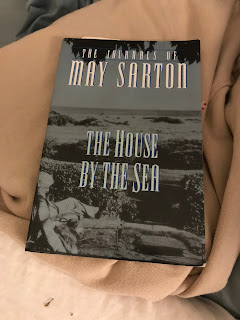
"...to live the slow quiet rhythm of a day as a kind of healing" Several years ago, I discovered May Sarton’s journals. What a b...
-
 photo by Amy Brandon "You are privileged to read these words so many are barred from. And why are they barred? Because the Nazis...
 -
 photo by Anna Reavis "I went to the woods because I wished to live deliberately, to front only the essential facts of life, and...